
Key Points
- Stanford researchers developed a noninvasive method of using focused ultrasound to generate light deep inside the body.
- The process enables precise control of biological processes through light-based interventions.

The research team at Stanford University led by Guosong Hong, PhD, recently published comprehensive study results in Nature Materials, a high-impact journal. Throughout this project, they created a groundbreaking technique that uses focused ultrasound to generate light deep inside the body, without surgery or implanted devices. Their innovative approach opens the door to highly precise, noninvasive control of biological processes through light-based interventions. Examples of these types of processes are gene editing, photodynamic therapy, deep-tissue imaging, and drug delivery.
Early joint funding provided by the Focused Ultrasound Foundation together with the Spinal Muscular Atrophy Foundation helped establish the feasibility of the approach, which led to additional funding (e.g., an NIH BRAIN Initiative R01 grant) and the final development of the comprehensive technique.
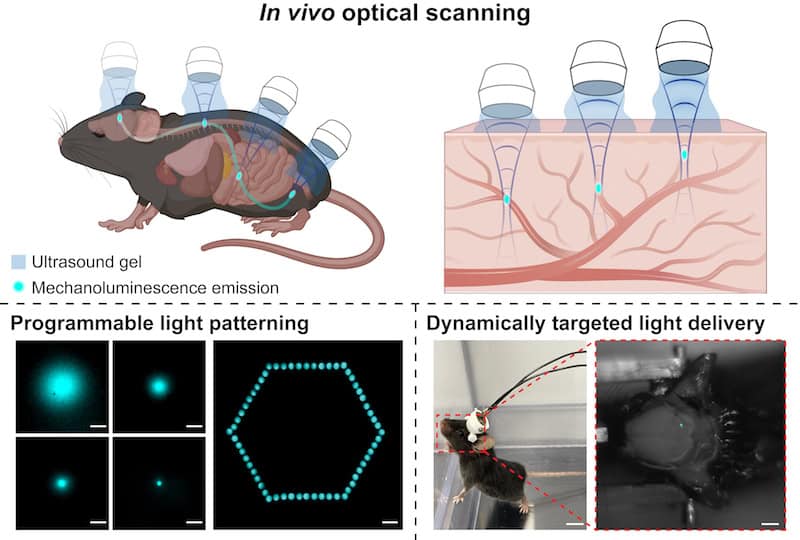
An Ultrasound-Scanning In Vivo Light Source
The goal of the research was to overcome a longstanding challenge: how to deliver light to specific locations inside the body with both high precision and flexibility. Light is widely used in biology and medicine research, for example to activate genes or control neurons, but typically requires invasive optical fibers or is limited to shallow tissues.
To address the challenge, the team engineered tiny mechanoluminescent nanoparticles that circulate through the bloodstream. When stimulated by focused ultrasound, the particles emitted light exactly where the ultrasound was directed. By scanning the ultrasound beam, researchers could “paint” light patterns deep inside tissues in real time.
The results are striking. In animal studies, the system achieved sub-millimeter precision and was able to target multiple regions throughout the brain and body. To demonstrate its potential for controlling biological activity, the researchers used a technique known as optogenetics, where cells are genetically engineered to respond to light. Using this approach, they were able to activate light-sensitive neurons in the brain and spinal cord, and in turn influence behavior, all without surgery. In other organs, the study demonstrated precise, targeted light delivery, highlighting the potential for future applications beyond the nervous system.
“My lab is currently working with Michael Lin’s lab to pair this light-producing method with a gene-editing system,” said Dr. Hong. “We envision using ultrasound to achieve spatiotemporally precise gene editing as a noninvasive therapeutic strategy for spinal muscular atrophy, a genetic disorder caused by mutations in the survival motor neuron 1 gene (SMN1).” [Read more about this next project at “Interdisciplinary Initiatives Program Seed Grant: Ultrasound-Controlled in vivo Gene Editing via Photoswitchable CRISPR-Cas9.”]
This breakthrough builds directly on work supported by the Focused Ultrasound Foundation. Initial funding enabled the team to demonstrate that ultrasound could trigger light emission inside living animals and achieve localized activation with high spatial precision. These foundational studies also showed that the emitted light was strong and fast enough to drive biological effects such as gene activation.
“These are exciting results demonstrating how focused ultrasound can act as a noninvasive ‘switch’ to control gene and cell therapies with light, particularly for neurological disorders where precise, localized activation is critical,” said Frédéric Padilla, PhD, director of the Foundation’s Gene and Cell Therapy Program.
Together, the body of work described in the publication represents a major step toward noninvasive, targeted therapies. By enabling precise control of where and when biological processes occur, ultrasound-mediated light delivery could one day support treatments for neurological disorders, genetic diseases, and beyond.
See the Stanford Report: Researchers Use Ultrasound to Create Light Inside the Body
Related Stories
Focused Ultrasound for Gene and Cell Therapy 2023 Workshop Participants
Research Awards Update: Eight Preclinical Projects Initiated in the Second Quarter of 2022