
Key Points
- Dogs with lymphoma and osteosarcoma are now being enrolled in clinicals trials at Purdue University in West Lafayette, Indiana.
- The research studies are part of the Werling Comparative Oncology Research Center’s innovative tumor ablation program.

The first patients have been treated in two clinical trials that are using focused ultrasound to treat common malignant tumors in dogs. The research studies, for osteosarcoma and lymphoma, are taking place at Purdue University College of Veterinary Medicine’s Werling Comparative Oncology Research Center as part of a new tumor ablation program.
Both of these prospective clinical trials are using the Theraclion EchoPulse system. The focused ultrasound for veterinary applications initiative at Purdue is being led by Nick Dervisis, DVM, PhD, DACVIM (Oncology), Michael Childress, DVM, MS, DACVIM, and Shawna Klahn, DVM, DACVIM (Oncology). Dr. Dervisis also serves as the Foundation’s senior advisor for veterinary initiatives.

Osteosarcoma Clinical Trial
The osteosarcoma trial is evaluating the safety, feasibility, and biological effects of using focused ultrasound to treat dogs with newly diagnosed appendicular osteosarcoma. This aggressive cancer often affects the longer leg bones in large dogs. After applying focused ultrasound to the tumor site, researchers will assess changes in the tumor microenvironment and immune response to inform future combination approaches with immune-based therapies.
Participants first undergo pre-treatment functional imaging to plan the procedure. Researchers will then partially ablate the tumor using focused ultrasound under anesthesia. Follow-up scans will be completed after approximately a week, immediately before standard-of-care amputation of the limb. After recovery, the dogs will begin adjuvant chemotherapy.
Eligible dogs must be at least one year old and weigh more than 18 pounds. The University is covering the cost of the focused ultrasound treatment, up to $2,600 toward surgical amputation, and follow-up visits.
Lymphoma Clinical Trial
The second clinical trial is for the treatment of lymphoma, one of the most common cancers in dogs. The goal of this research is to safely destroy part of a cancerous lymph node and stimulate the immune system to help fight the cancer throughout the body.
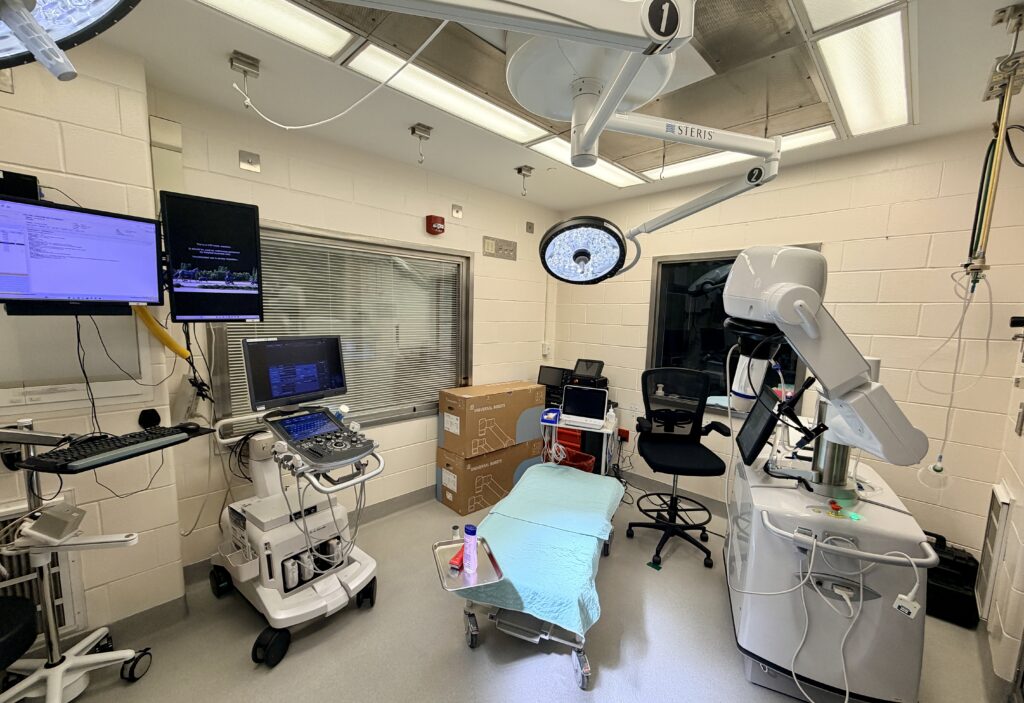
Before treatment, the team will take a needle biopsy of an unaffected lymph node to set a baseline. Participants will then undergo a single focused ultrasound lymph node treatment. Approximately one week later, the team will compare the treated lymph node with an untreated node and also assess blood samples for immune changes. All dogs will then receive a full 25-week course of standard chemotherapy using the “CHOP protocol” – a regimen of chemotherapeutics including cyclophosphamide, doxorubicin, vincristine (Oncovin), and prednisolone – for patients with aggressive non-Hodgkin’s lymphoma.
Eligible dogs must be at least one year old, weigh more than 18 pounds, and have a confirmed diagnosis of intermediate or large-cell, multicentric lymphoma (B- or T-cell).
Purdue will cover the cost of the focused ultrasound procedure plus all biopsies and blood tests as outlined in the trial protocol. Additionally, owners will receive a $2,000 credit toward the cost of the CHOP chemotherapy protocol and up to $2,000 in additional support for managing any side effects linked to focused ultrasound or to be applied toward CHOP therapy.
“Treating these first patients represents a defining milestone for our program,” said Dr. Dervisis. “It reflects years of collaboration and preparation to bring advanced ablation technologies into a clinically embedded, translational research environment. I am proud of the close cross-disciplinary collaboration among oncologists, anesthesiologists, radiologists, immunologists, medical physicists, and engineers, with a central goal of improving our understanding of how tumor ablation initiates anti-tumor immune responses and modulates the tumor microenvironment.”
Both studies are being funded by the Focused Ultrasound Foundation.
“This trial represents an important step forward as we explore focused ultrasound as a safer treatment for companion animals with this deadly cancer,” said Tonya Cherukuri, PhD, director of the Foundation’s Veterinary Program. “The Foundation is committed to promoting the One Medicine Initiative, where improving the lives of animals through focused ultrasound can also inform better treatments for humans.”
About Purdue’s Tumor Ablation Program
The tumor ablation program at the Werling Center brings advanced noninvasive and minimally invasive tumor destruction technologies to pets with cancer by integrating real-time imaging, such as ultrasound and CT, and functional imaging to precisely plan, guide, and monitor treatments while protecting surrounding healthy tissue.
The program encompasses several directed energy–based ablation strategies designed to irreversibly disrupt tumor viability, structure, and function. Technologies such as thermal focused ultrasound, pulsed field ablation, and histotripsy enable precise tumor targeting while minimizing collateral damage and are delivered within clinical trials that both expand treatment options for patients and accelerate discovery across species.
The tumor ablation team leading these efforts includes Dr. Dervisis, Dr. Childress, Dr. Klahn, and Keith Stanz (Medical Physics), along with research technicians Deb Stevenson and Kelly Martin. Their work reflects a highly coordinated, multidisciplinary approach to safely and effectively deliver advanced therapies in a clinical setting.
For Patients
Learn more about the osteosarcoma clinical trial.
Learn more about the lymphoma clinical trial.
For either trial, you may also contact the Oncology Tumor Ablation Service at [email protected] or 765-494-1130.
Related Stories
Foundation Research Awards Update: Six Preclinical Projects Launched in Fourth Quarter 2025 January 2026
Foundation Welcomes Senior Advisor for Veterinary Initiatives April 2023
Veterinary Program Milestone: Focused Ultrasound Safely Treats Canine Tumors August 2022